
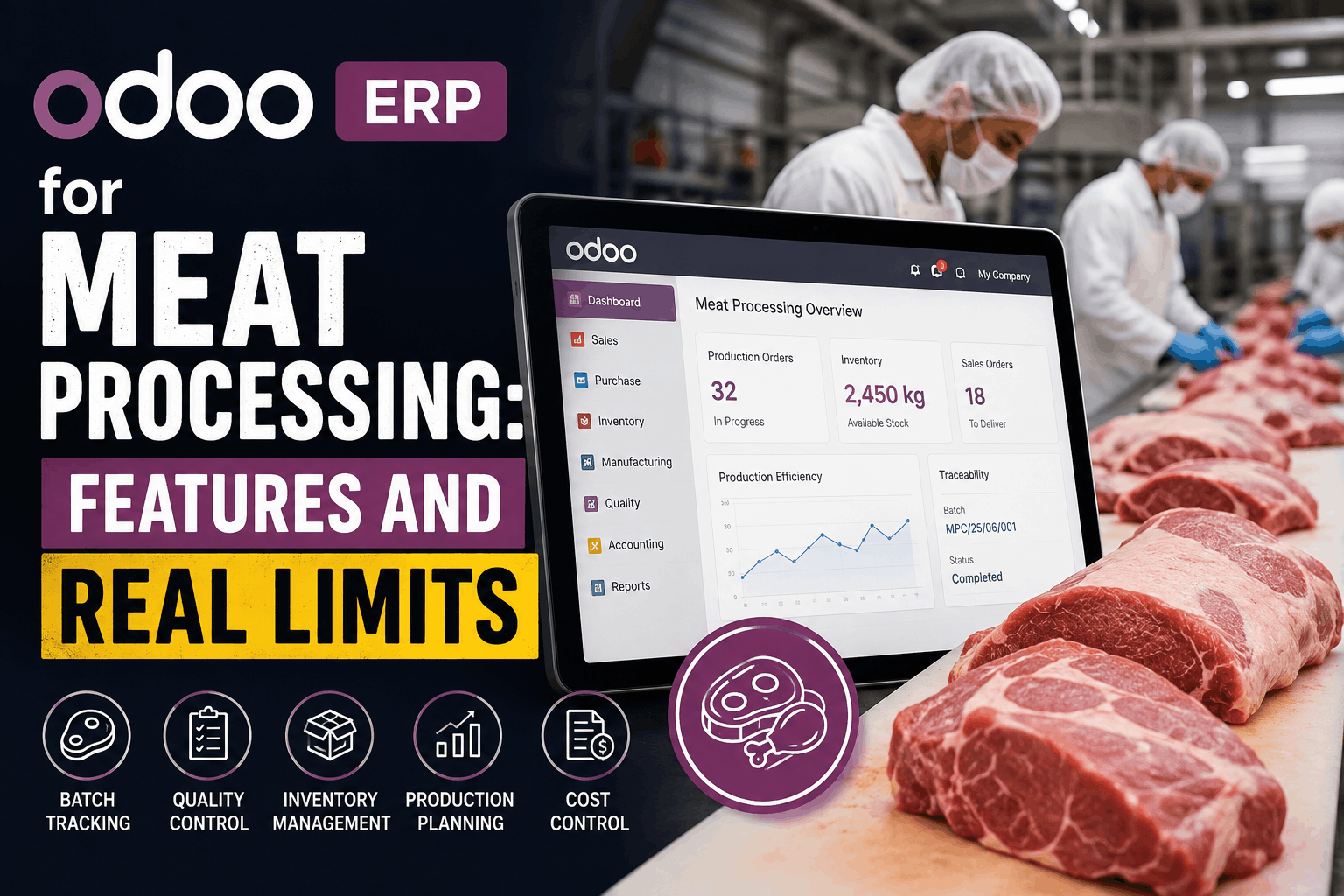
A meat processing unit runs on numbers that most software was never built to handle well. A live animal comes in at one weight, the carcass yields a different weight after dressing, and the final packed product is priced by the kilogram of a cut that nobody could predict in advance. Add a recall requirement, a cold chain that cannot break for even an hour, and export paperwork that changes by destination country, and it becomes clear why a generic accounting-plus-inventory system falls short.
This article looks at what Odoo ERP actually does for meat processing operations, where its standard functionality lines up cleanly with how the industry works, and where it does not. If you are evaluating Odoo for a slaughterhouse, a cut-and-pack unit, or an integrated meat processing plant, the goal here is to give you a realistic picture before you book a demo, not a list of module names.
What a Meat Processing Operation Actually Needs From Software
Before looking at Odoo specifically, it helps to separate the requirements that are unique to this industry from the ones any manufacturer shares.
Every meat processing business needs to manage purchase of livestock or primary raw material, production planning, inventory, sales, and accounting, the same as any manufacturer. What makes meat processing different is a cluster of operational realities:
- Variable output weight. A batch of 50 live birds or animals does not produce a fixed, predictable quantity of finished product. Dressing percentage varies with breed, feed, and handling.
- Multiple saleable outputs from one input. A single carcass breaks down into primal cuts, sub-primal cuts, offal, fat, bone, and sometimes rendered by-products, each sold at a different price point.
- Perishability and cold chain dependency. Shelf life is measured in days, and any break in temperature control affects food safety, not just quality.
- Strict traceability requirements. Regulators and export buyers expect a business to trace any pack of product back to the animal lot and forward to the customer it was sold to, usually within a short window.
- Regulatory and certification layers. In India, this means FSSAI compliance. For export to Middle Eastern markets, it usually means halal certification and destination-country sanitary requirements on top of domestic food safety law.
A software platform that ignores these realities and simply repackages generic manufacturing terminology will create more manual workarounds than it removes.
Where Standard Odoo Covers Meat Processing Well
Odoo’s Manufacturing, Inventory, Quality, Purchase, and Accounting applications, used together, cover a meaningful share of what a meat processing unit needs without custom development.
Multi-Level Bills of Materials and By-Product Routing
Odoo ERP for meat processing supports multi-level Bills of Materials, which matters here because meat processing is rarely a single-step conversion. A carcass typically goes through a kill floor stage, a chilling stage, and then a cutting or deboning stage, and each stage can be represented as its own manufacturing order linked through the BOM structure.
More importantly, Odoo Manufacturing supports by-products on a BOM. This means a single manufacturing order for carcass breakdown can output the primary cut as the main product while also recording offal, bone, and fat as by-products with their own valuation, rather than treating them as waste or ignoring them in the costing calculation. This is one of the more genuinely useful fits between standard Odoo and how meat processing actually works.
Work Centers and Routing for the Processing Line
Odoo lets you define separate work centers for stages like slaughter, chilling, deboning, and packing, each with its own capacity and time standards. Production can then be tracked stage by stage instead of as one undifferentiated “manufacturing” step, which gives more accurate labor and capacity data across a plant that genuinely has different bottlenecks at different points.
Lot and Serial Number Traceability
The Inventory app’s lot and serial number tracking is directly relevant to a recall scenario. Every incoming batch of livestock or raw meat can be assigned a lot number at receipt, and Odoo carries that lot reference through manufacturing into the finished pack. The traceability report can then show, for any finished lot, which incoming raw material lots contributed to it, and for any incoming lot, which finished products it ended up in. This one-up-one-down structure is what most food safety audits and recall procedures actually ask for.
Quality Control Points and Quality Alerts
The Quality app allows you to define Quality Control Points at specific stages, for example a check after chilling or before packing, and attach a quality check to a manufacturing or transfer operation automatically. If a check fails, it can generate a Quality Alert that routes to whoever is responsible for corrective action, which creates a documented trail rather than a verbal instruction that nobody logs.
Expiry Dates and FEFO Stock Management
Because Odoo can track expiration dates and best-before dates at the lot level, it supports first-expired-first-out removal strategies in the warehouse. For a business handling chilled and frozen meat with genuinely limited shelf life, this reduces the risk of older stock sitting behind newer stock on the same shelf.
Where Standard Odoo Falls Short and Needs Configuration or Custom Work
This is the part most vendor content skips, and it is the part that actually determines whether an implementation goes smoothly or turns into a series of change requests six months in.
Catch-Weight Pricing Is Not Native
The biggest gap is catch-weight, the practice of selling a product by a unit (a box, a piece, a carton) while pricing it based on the actual variable weight recorded at packing. Standard Odoo works on the assumption that a unit of measure has a fixed conversion, which does not hold for meat products where every box of the same SKU can weigh a slightly different amount. Handling this properly in Odoo requires either a purpose-built add-on for catch-weight or custom development on top of the Sales, Inventory, and Invoicing flow. Any vendor who tells you this works out of the box in standard Odoo is not describing the product accurately.
Yield and Dressing Percentage Reporting
Odoo will record and value a by-product once a manufacturing order is confirmed, but it does not natively give you an industry-style yield report, for example dressing percentage trends across suppliers or breeds over time. This kind of analysis is usually built through custom reporting on top of the manufacturing data Odoo already captures, rather than something you configure through the standard settings screen.
Cold Chain Temperature Logging
Odoo does not include built-in integration with temperature sensors or cold storage monitoring equipment. If your operation needs automated temperature logging tied to a specific batch or storage location for compliance evidence, this typically comes from a specialized IoT or monitoring system with its own dashboard, potentially integrated with Odoo through the API for record-keeping rather than run inside Odoo itself.
Livestock-Specific Procurement Terms
Purchasing live animals often involves grading, weighbridge tickets, and settlement based on live weight versus dressed weight, which differs from a standard purchase order for finished goods. Odoo’s Purchase app handles the commercial document flow well, but the grading and weight-settlement logic usually needs configuration through custom fields or a small extension rather than a standard feature.
A Practical Example: Recall Traceability in Odoo
Consider a mid-sized poultry processing unit receiving live birds from three different farms in a single week, each recorded under a separate lot number at goods receipt. The birds move through slaughter, chilling, and cutting, and the cut chicken is packed into cartons that are sold to five different retail customers over the following four days.
If a quality complaint comes in about one carton from one retail customer, the traceability report in Odoo can be used to identify the manufacturing order that produced that carton, the lot numbers of raw material consumed in that manufacturing order, and by extension, which farm supplied the birds involved. Working in the other direction, if a farm reports an issue with a specific flock after delivery, the same lot reference can be used to identify every finished carton and every customer that received product made from that lot, so the recall can be scoped accurately instead of pulling stock from every customer as a precaution.
This is the practical value of lot traceability done correctly, and it is one of the stronger reasons meat processing units consider Odoo in the first place.
Standard Odoo vs. Odoo ERP for meat processing Customization
| Requirement | Standard Odoo | Odoo ERP for meat processing |
| Multi-level BOM and by-products | Fully supported | Not needed |
| Lot and serial traceability | Fully supported | Not needed |
| Quality control points and alerts | Fully supported | Minor config for industry-specific checks |
| FEFO stock removal | Fully supported | Not needed |
| Catch-weight pricing and invoicing | Not supported | Add-on or custom development required |
| Dressing percentage and yield analytics | Partially supported via mfg data | Custom reporting layer needed |
| Cold chain temperature logging | Not supported | External system, integrated via API |
| Livestock weight-based settlement | Partially supported | Custom fields or extension on Purchase |
Where This Leaves You
Odoo erp for meat processing the manufacturing backbone of meat processing well: multi-level BOMs, by-products, work centers, lot traceability, quality control points, and FEFO stock handling are all genuinely built into the platform, not bolted on. The parts that need honest attention before you sign off on an implementation are catch-weight pricing, yield analytics, and cold chain monitoring, none of which come standard.
If you are still comparing what this looks like in practice, walking through an actual Odoo Demo for Food Processing is a more reliable way to judge fit than reading a feature list, since you can see how lot traceability and by-product handling behave with data that resembles your own production.
Frequently Ask Questions
Does Odoo ERP for meat processing support catch-weight products for meat processing out of the box?
No. Standard Odoo does not have native catch-weight functionality. Selling by unit while pricing by actual recorded weight requires a dedicated add-on or custom development on the sales and inventory flow.
Can Odoo handle FSSAI or halal compliance documentation?
Odoo does not include FSSAI or halal certification modules by default, but its Quality app and document management can be configured to store certificates, run compliance-related quality checks, and maintain the records an audit would ask for. The certification process itself remains an external regulatory step.
How does Odoo track a product back to the animal or farm it came from?
Through lot and serial number tracking in the Inventory app. Raw material is received under a lot number, and that reference carries through manufacturing orders into the finished product, so the traceability report can trace forward and backward.
Is Odoo suitable for a small meat processing unit or only large operations?
Odoo scales down reasonably well because you can implement only the applications you need, for example Inventory, Purchase, and Sales without Manufacturing, if the operation does not require detailed production tracking. Smaller units sometimes start with a lighter setup and add Manufacturing and Quality later.
Does Odoo manage by-products like offal, fat, and bone separately from the main cut?
Yes. Odoo Manufacturing supports by-products on a Bill of Materials, so these outputs are recorded and valued separately from the primary product rather than absorbed into it or ignored.
What is the typical timeline to implement Odoo for a meat processing plant?
This depends heavily on how much customization the operation needs, particularly around catch-weight and yield reporting. A relatively standard setup covering Purchase, Inventory, and Sales can move faster than an implementation that also needs catch-weight invoicing and custom yield analytics built and tested.